
Table of Contents
Vietnam’s education sector has gained more attention in the recent decade. Compared to five years ago, the number of foreign investment projects in Vietnam’s education has climbed by 321, with a total registered capital of about US$3.5 billion. According to the deputy minister, however, foreign investment in education has not been commensurate with its potential. Particularly, Vietnam’s early childhood education still holds great opportunities to seize.
The Government’s supporting policies in early childhood education
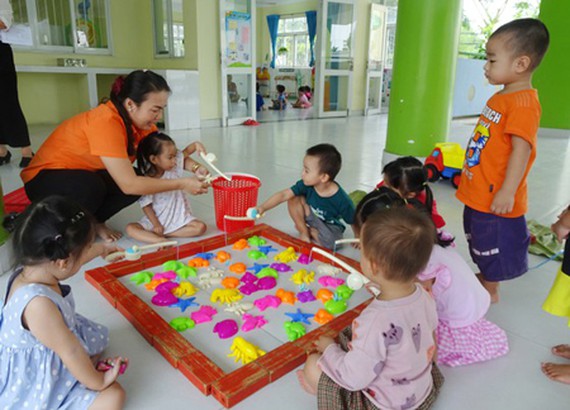
According to Vietnam’s Culture and Education Policy (1972), education for children ages between three and five is preschool education. There are 2 main forms of school: state-run (public) preschools and non-state (private) ones. State-run kindergartens account for almost half of Vietnam’s preschool system. Besides, there are private kindergartens that use Vietnamese as the main language of teaching, and international kindergartens located in major cities that use English as the medium of instruction.
Over the last 10 years, the Vietnam Government has significantly softened its approach to foreign investment. Although there are still foreign ownership restrictions in place for a number of sectors, education is one of the exceptions. However, it is still a sector in which the Government has approval authority over foreign investments.
To encourage investment in kindergartens and K-12 schools, in 2018, the Government published Decree No.86/2018/ND-CP replacing Decree No.73/2012/ND-CP. Under the old regulation, the proportion of Vietnamese students in international schools must be 0-20 percent depending on the stage of education.
However, under the new Decree No 86, Vietnamese students can make up roughly half of all pupils in schools. This paved the way for increased investment in kindergartens and K-12 institutions.
It used to be difficult for parents to enroll their children in international schools. Mainly the well-off parents could afford to send their children to these schools. However, thanks to the new law, middle-class families are also sending their children to international schools.
In 2021, The Ministry of Education and Training (MOET) has announced a draft decree updating Decree 86 of 2018. It concentrated on regulations on management of joint education programs toward higher efficiency and transparency.
Notably, the draft includes private preschool education institutions and private general education institutions to the list of businesses that can collaborate on education with foreign parties. To mitigate the financial burden of investors investing in the education sector during the early stage, the draft allows investors to disburse investment capital according to a set roadmap.
However, it still requires them to commit to completing the contribution of investment capital within five years after obtaining an operation license. For the year 2021-2025, the Government continues to develop more favorable conditions to increase investment in education and preschools particularly.
Urban migration increases demand in preschool education institutions
The major cities’ economy is developing rapidly and attracting a large number of workers and employees. As a result, urban migration in Vietnam is rapidly increasing: Every year, around 1-1.2 million individuals migrate to cities.
According to Urbanet, Vietnam’s six major cities will grow significantly by 2030. The population of Ho Chi Minh City will grow by about 4 million people to 11.1 million over the next decade. Hanoi, the country’s capital and second-largest city, is expected to grow by 2.7 million people to 6.4 million.
Consequently, the demand for preschool education institutions is occuring at a rapid pace. However, urbanization puts strain on the educational system. It exhausts the capacity of public schools. According to the ministry, the number of preschool aged students increases by 250,000 every year. In the last 10 years, the number of private and public kindergartens increased by 2,634. Meanwhile, the number of children went up by 1.5 million.
Nguyen Ba Minh who heads the Department of Early Childhood Education (ECED) stressed that early childhood education is a must. However, due to urban population explosion, the sector has faced difficulties in meeting the rising demand. For example in 2020, Ho Chi Minh City had nearly 880 private kindergartens. However, the number of classrooms available fell short of demand, and the number of students per classroom remained too high.
Vietnam now has nearly five million children aged three to five years old. At this time, it is advisable for investors to expand the number of private kindergarten classes to meet the huge demand in several big cities like Hanoi, Hai Phong and Ho Chi Minh.
Expanding middle income population increases demand in private and international preschools
Parents in Vietnam place a high value on their children’s education. One of the key drivers of education investment in Vietnam is the increase in income and the growth of the middle class. Vietnam has had stable GDP growth of between 5% and 7% from 2013 to 2017, and average incomes of its citizens grew by a CAGR of 11.6% from 2012 to 2016.
By 2030 or earlier, the middle class is predicted to reach 40% of the population. This growing middle class will lead to higher demand and consumption of non-necessity products and services, such as world-standard education mainly available in international schools.
Furthermore, Vietnam has a favorable demographic structure for the growth of the education sector. It has a population of more than 96 million people, 60% of whom are under 40 years old and 34.4% living in metropolitan areas.
People of the 7x-8x and even 9x generations – those with a good education and high income – are starting to have children. These young parents have a great desire for high-quality education. They are willing to invest more to ensure that their children have access to the necessary knowledge and skills.
Moreover, Vietnam has been progressively integrating into the global market as a developing economy. This results in a growing demand for high-quality human resources. Having a good education background can improve individual competitiveness in the future.
Therefore, Vietnamese parents are seeking an international education environment where their children can be proficient in English and obtain a global-citizen mindset at a young age. For that reason, investing in international institutions that use English as the medium of instruction would yield great benefits for investors.
The impact of Covid-19 pandemic
Due to the Covid-19 outbreak, several private kindergartens have been forced. This resulted in a preschool crisis in Hanoi and Ho Chi Minh City. According to the education ministry, 28,500 kindergartens across the country had to suspend operation during the lockdown, while 584 private schools were dissolved.
Since April 2022, students have returned to school, even the preschool-aged students. However, because too many private kindergartens were to stop operations due to financial difficulties, state-run schools were too overloaded when the children returned to the class.
The prolonged lockdown also resulted in the alarming shortage of preschool teachers. Meanwhile, the number of students per class increased significantly. Vietnam is lacking qualified local instructors and teachers. This is why foreign talents are very important and are an appealing reason to invest in the education sector.
Deputy Minister Nguyen Van Phuc expressed his hope that Vietnam would have more private education institutions by both domestic and foreign investors. The Vietnam Government always supports and provides favorable conditions for investors in this sector, he added.
With comprehensive knowledge of Vietnam’s education sector, Vietonkin can help you set up your education business in Vietnam. Our experts who are experienced and familiar with the market are confident to help investors seize the most valuable opportunity!


