
Table of Contents
In response to the outbreak of the Covid-19 pandemic, the Vietnamese government acted swiftly to implement a range of favorable measures, such as tax reductions and extensions to support businesses impacted by the crisis and stimulate the recovery of the domestic economy. As Vietnam moves into the mid-year of 2023, the government has already approved a comprehensive tax reduction and extension policy, reflecting their commitment to sustaining economic stability and facilitating the growth of businesses in the country.
Tax Reduction Policy
On May 17, 2023, the National Assembly Standing Committee issued Notice No. 2298/TB-TTKQH, providing important information regarding the VAT reduction policy in Vietnam. According to the notice, the VAT reduction policy will be implemented from July 1st, 2023 to December 31, 2023, based on Resolution No. 43/2022/QH15.
However, it is important to understand the eligibility criteria for this VAT reduction. The notice clarifies that certain goods and services will be exempt from the VAT reduction. These include telecommunications, financial activities, banking, securities, insurance, real estate trading, metals, and prefabricated metal products, mining products (excluding coal mining), coke, refined petroleum, chemical products, products, and services subject to excise tax, and information technology in accordance with the law on information technology.
Additionally, a 20% reduction in the VAT calculation percentage will be implemented for business establishments, including business households and individuals, when issuing invoices for goods and services subject to a 10% VAT liability.
The objective of this plan is to strategically boost consumption demand in alignment with the current economic landscape, thereby revitalizing and fostering the prompt recovery and development of production and business activities, ultimately benefiting our nation’s economy
Ho Duc Phuc, Minister of Finance.
The government anticipates a reduction in state budget revenue of approximately 5.8 trillion VND per month. If implemented during the final six months of the year, this reduction would amount to around 35 trillion VND. However, the policy’s impact will extend beyond revenue reduction. By lowering the cost of goods and services, it will stimulate production and business activities, generating more job opportunities and contributing to both macroeconomic stability and regional economic recovery in 2023.
Financial experts widely recognize the significance of this VAT reduction policy for businesses and individuals, especially given the challenging business landscape experienced in the first quarter of 2023.
VAT is embedded in the price structure, and a 2% reduction in VAT will not only decrease the selling price of goods and services but also stimulate consumption, thereby assisting businesses in increasing their sales volume. Furthermore, for manufacturing enterprises reliant on input materials, VAT reduction will effectively reduce input costs, thereby igniting production
A representative of the Vietnam Tax Consultants Association.
2023 Tax Extension Regulations
Together with the tax reduction policy, the implementation of tax extension is crucial in boosting business activities and triggering purchasing demand within the domestic market.
Who Qualifies for the New Tax Extensions?
In accordance with Article 3, Decree 12/2023/NĐ-CP, there are 4 major categories of taxpayers that are eligible under the new tax extension regulation, including manufacturing enterprises, enterprises in specific economic sectors, industry product manufacturers and key mechanical product producers, small and micro-enterprises.
- Manufacturing Enterprises: This category encompasses a wide range of industries, including agriculture, forestry, fishery, production, construction, and crude oil extraction (excluding corporate income tax on crude oil, condensate, and natural gas collected under agreements or contracts). Manufacturing enterprises within these sectors can take advantage of the tax extension policy to alleviate financial burdens and enhance their competitiveness.
- Enterprises in Specific Economic Sectors: Businesses operating in sectors such as transport, warehousing, labor, and employment services can also reap the rewards of the tax extension policy. These sectors play a crucial role in supporting the overall economy, and by extending their tax obligations, the policy enables them to allocate resources more efficiently and fuel their growth.
- Supporting Industry Product Manufacturers and Key Mechanical Product Producers: Supporting Industry Product Manufacturers and Key Mechanical Product Producers: Enterprises, organizations, households, business households, and individuals involved in the production of supporting industry products prioritized for development and key mechanical products are given special consideration.
- Small and Micro-Enterprises: Small and micro-enterprises operating in the commerce and services sectors, employing no more than 10 laborers with an average annual contribution and having a total revenue not exceeding 10 billion VND or total capital not exceeding 3 billion VND, fall under this category. The tax extension policy aims to support these businesses, which form the backbone of the economy, by reducing their tax burden and fostering a favorable environment for their growth and prosperity.
As Vietnam strides confidently towards a brighter future, these tax extensions serve as catalysts of progress. Through the government’s visionary approach, a tapestry of industries now thrives, each endowed with its unique potential. The journey ahead beckons with promise and possibility, as enterprises embark on a transformative path, fostering economic prosperity and igniting the nation’s spirit of innovation.
Terms and Conditions
The new tax extension policy introduces specific rules to facilitate the payment of value-added tax (VAT) and corporate income tax (CIT). Here are the key rules that taxpayers should be aware of:
VAT Tax:
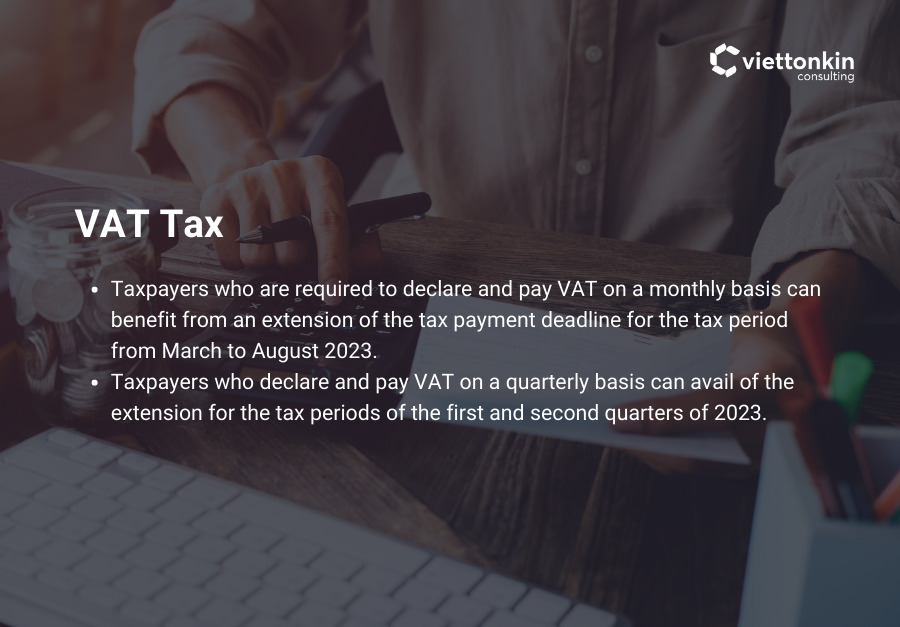
- Taxpayers who are required to declare and pay VAT on a monthly basis can benefit from an extension of the tax payment deadline for the tax period from March to August 2023.
- Taxpayers who declare and pay VAT on a quarterly basis can avail of the extension for the tax periods of the first and second quarters of 2023.
Extension Period for VAT:
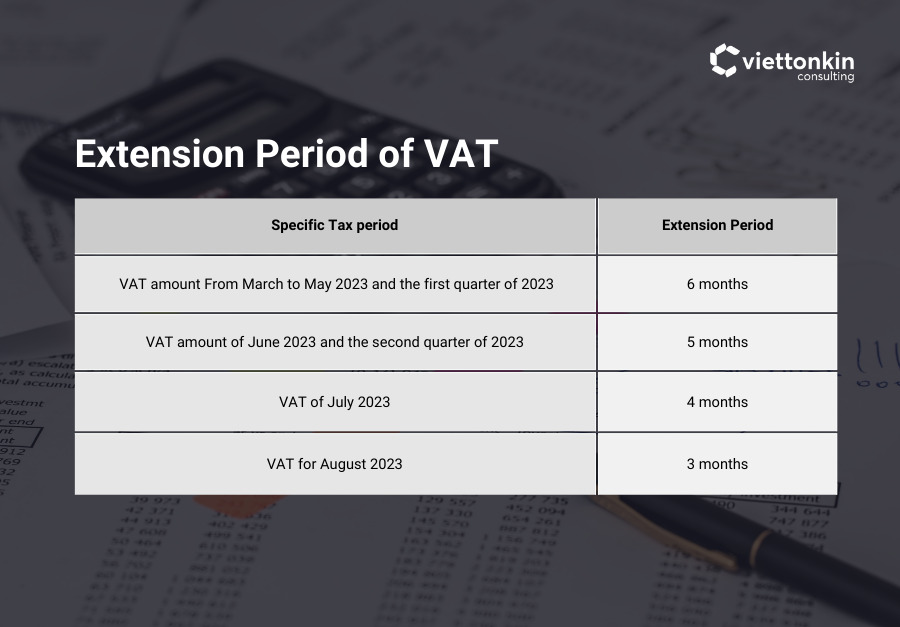
The extension period for VAT payments varies depending on the specific tax period:
- For the value-added tax amounts from March to May 2023 and the first quarter of 2023, the extension period is 6 months.
- For the value-added tax amount of June 2023 and the second quarter of 2023, the extension period is 5 months.
- For the value-added tax amount of July 2023, the extension period is 4 months, and for August 2023, the extension period is 3 months.
CIT:
- The tax extension policy also covers the payment of corporate income tax.
- Taxpayers can benefit from an extension of the tax payment deadline for the temporarily paid corporate income tax amounts of the first and second quarters of the corporate income tax period in 2023.
- The extension period for corporate income tax is 3 months, starting from the end of the original deadline for paying corporate income tax, as stipulated by the law on tax administration.

How to File for a Tax Extension
During the process of filing for a tax extension, taxpayers must be aware of important notes to ensure compliance and avoid any potential issues. Here are the key points to keep in mind:
- Submission of Extension Application: Taxpayers must complete and submit an application form for extension to the managing tax authority. This application should cover the entire tax amount incurred during the tax-extended period. The application form should be submitted concurrently with the monthly or quarterly tax returns, following the regulations stipulated in the tax administration law.
- Deadline for Application Submission: If the extension application is not submitted simultaneously with the monthly or quarterly tax returns, taxpayers have until September 30, 2023, to submit the application. It is important to adhere to this deadline to ensure eligibility for the tax payment extension.
- Responsibility of Taxpayers: Taxpayers are responsible for determining and ensuring that their extension requests fulfill the criteria specified in the decree. If the taxpayer submits the extension request to the tax authority after September 30, 2023, the tax payment extension will not be granted.
- Notification of Acceptance: Tax authorities are not obligated to notify taxpayers regarding the acceptance of their tax payment extension request. It is the responsibility of the taxpayers to make the extension request and keep track of its status.
- Notification of Ineligibility: If, during the extension period, the tax authority determines that a taxpayer is not eligible for the extension, they will send a written notice to the taxpayer, explaining the decision.
- Post-Extension Verification: Following the expiration of the extension period, if a competent state agency conducts an inspection and determines that the taxpayer was not eligible for the extension as outlined in the decree, the taxpayer must settle the outstanding tax amount, along with fines and late payment interest, to the state budget.
Being aware of these important notes, taxpayers can ensure compliance throughout the tax extension process. It is crucial to adhere to the deadlines, maintain accurate records, and take responsibility for submitting the extension request on time. This will help prevent any potential complications and allow for a smooth and compliant tax filing experience.
Tax Reduction & Extension Policy Impact on Vietnam’s Economy
In 2022, with the introduction of tax reduction and extension policy, Vietnam’s economy has witnessed an impressive recovery. This strategic intervention, implemented with precision and directed towards the right sectors focused on the right sectors, led to an astounding 15% increase in enterprise investment capital compared to the previous year. The ripple effect was felt across the board, with a staggering 20% surge in total retail sales of consumer goods and services, and an impressive 9.5% growth in people’s incomes.
On April 17, 2023, the esteemed state-owned publication agency, Investment Newspaper, expressed its unequivocal stance on the matter: the impact of tax extension, exemption, and reduction policies has been too significant to overlook. Hence, it is crucial to continue implementing these policies without delay. The urgency stems from the fact that difficulties have surfaced and become increasingly apparent since the fourth quarter of 2022. According to a recent statistical survey conducted by the General Statistics Office, a staggering 52.4% of businesses are grappling with challenges stemming from sluggish domestic demand. Among them, over 30% face financial hurdles, while 37% struggle due to borrowing capital from banks burdened with exorbitant interest rates.
Given this complex landscape, the proactive implementation of business support policies, particularly through tax reduction and extension, starting from the beginning of 2023, serves as a timely and critical intervention. By doing so, Vietnam can effectively contain the spread of these challenges and propel the recovery of the domestic economy within the post-Covid-19 context. Not only will this mitigate the global recessionary impact, but it will also lay the foundation for sustained economic growth, providing a favorable environment for businesses to thrive.
Final Thoughts
By reducing the VAT rate and extending tax benefits to specific sectors, the government aims to promote consumption, boost production, and create more job opportunities. However, navigating the intricacies of tax regulations and ensuring compliance can be challenging for businesses and investors. That’s where Viettonkin’s legal consulting services come into play. Our team of experienced professionals can provide expert guidance and support, helping businesses understand the nuances of the tax extension policy and assisting them in avoiding any legal violations.
Don’t let the complexities of tax regulations hinder your business growth. With us by your side, you can navigate the tax landscape with confidence and focus on what matters most—growing your business in the dynamic market of Vietnam.
Contact Viettonkin today and embrace the full potential of your business.


