
Table of Contents
Investment in the establishment of a foreign investment company-PT PMA is one strategic way that foreign investors use to penetrate the market of Indonesia, which is developing very fast. Erizka Permatasari, a bachelor of law who provides this through HukumOnline.com: PT PMA is a lawful activities which allow foreign companies to operate and invest in Indonesia with an option to possess foreign-owned companies while business develops in one of the most active economies in Southeast Asia. This shows how significant PT PMA is in providing a clear and regulated avenue for foreign capital to flow into Indonesia, boosting economic activities by stimulating growth, encouraging innovation, and creating jobs (Erizka Permatasari, 2020).
The main advantages of using a PT PMA are basically flexibility in foreign ownership and structuring of capital. It is upon the discretion of the Indonesian Government’s policies where there are a variety of industries that allow foreign investors to fully own 100% shares in the company.
Further, PT PMA opens up enormous business fields in manufacturing, services, and technology and, therefore, is an important medium in terms of the success of foreign investors to be successful in the competitive business arena of Indonesia.
The PT PMAs have increased considerably in Indonesia by 2023, for which the recent statistics are representing more than 30,000 foreign investment companies in Indonesia.
This reflects an increase in the attractiveness of Indonesia as a ‘destination of choice’ for foreign investment. The government also streamlined the procedures of registration, along with small incentives that helped foreign investors improve upon their compliance with the regulations and have their businesses placed upon sound footing.
This article will elaborate on what PT PMA is, the procedures for its establishment, and comprehensively outline the surrounding regulations and benefits. We are going to show why PT PMA establishment is not a step that can be missed for every foreigner doing business in Indonesia.
Key Takeaways:
- The establishment of a foreign investment company is PT PMA, or in a more detailed explanation, Penanaman Modal Asing, which fits into the foreign investors’ strategic steps to participate in this country’s fast-moving market.
- The flexibility in setting up a PT PMA becomes a major plus, as it opens vistas regarding foreign ownership and structuring of capital.
- Up to 2023, the number of PT PMAs is significantly growing in Indonesia. It is said that there are now over 30,000 foreign investment companies in the country.
Definition of a Foreign Investment Company (PT PMA)

In accordance with Peraturan Badan Koordinasi Penanaman Modal Republik Indonesia Tahun 2019, underlining commitments to ease processes and convenience for foreign investors into the Indonesian market, foreign investment, normally abbreviated as PMA, means an investment activity of capital to run a business within the territory of the Republic of Indonesia, done by a foreign investor. This may be wholly foreign-owned or set up as a joint venture with a domestic investor.
According to Legalku.com, an online legal service facilitator for entrepreneurs to establish their businesses, PT PMA is a foreign limited liability company in Indonesia, which was set up with the investment of foreign investors. A PT PMA can be wholly owned by foreign investors or established as a partnership with domestic and foreign investors (Legalku.com, 2024).
The setting up and operation of a PT PMA are under the Investment Law No. 25 of 2007 of Indonesia, together with all other legal provisions that may apply. Being a company set up by foreign investors, a PT PMA should be in a position to observe whatever administrative and legal requirements are being required by the Indonesian government prior to its obtaining proper business licenses and permits applicable to the PT PMA’s line of operation. It should house the prevailing tax laws in Indonesia and labor regulations.
Requirements to Establish PT PMA Indonesia
According to Indonesia’s Investment Guidebook, drafted by the Ministry of Investment & Indonesia Investment Coordinating Board, to establish a PT PMA, there are some prerequisites that must be met. (Ministry of Investment & Indonesia Investment Coordinating Board, 2021):
- Each PT entity must have at least two shareholders; it can be all individuals, all corporate entities, or both combined.
- The minimum investment for a PT PMA is above IDR 10 billion, excluding land and building costs, for every five-digit KBLI number in which the project is located. In addition, the minimum paid-up capital should be established at USD 10 billion. Note that Representation Offices and Foreign Business Entities are excluded from these investment requirements.
These requirements will ensure significant contribution from PT PMAs to the Indonesian economy, while allowing a structure that will afford equal opportunity for domestic and foreign investment.
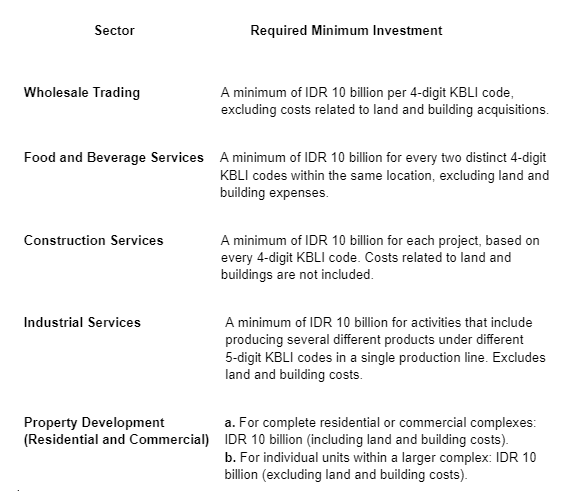
Besides that, not all business sectors are subject to the IDR 10 billion investment threshold. In particular:
- SEZs Technology-Based Start-ups: These are companies that could be deemed foreign investment with a reduced minimum capital, even less than the minimum IDR 10 billion, excluding the price of land and building costs.
This aligns with the goals of Indonesia to attract foreign investment but to have room for flexibility when it comes to truly innovative and technology-based businesses.
Also read: Unlocking Indonesia’s Potential: FDI Inflows at a Glance
How to Establish a Foreign Investment Company (PT PMA) in Indonesia: A Step-by-Step Guide
Establishment of a PT PMA (Foreign Direct Investment Company) in Indonesia is a multi-step process. Each step involves different requirements and procedures, each step needing to be well understood. These will surely guarantee a smooth company setup. Listed below are the steps involved in the process from KADIN Indonesia, the Indonesian Chamber of Commerce and Industry, which plays a very significant role in the development of a robust business climate in Indonesia (Sekretariat KADIN Indonesia, 2024):
Initial Licensing
The initial licensing is a step to commence the PT PMA by filing an application for an investment principle permit (Izin Prinsip) from the BKPM of Indonesia. This permit represents preliminary approval of conducting business activities in Indonesia.
This includes the preparation of the required documents for the business proposal and the structure of the company. The period of the principle permit itself is usually one year, in which, within that time period, the completion of other requirements has to be fulfilled. The permitting allows the company to take further steps in establishing the PT PMA.
Deed of Establishment
Consequent upon the grant of the principal license comes writing the Deed of Establishment. This is prepared by a local public notary, in which several fundamental details of the company are specified, like the name and address, objectives of the business, and ownership structure.
After all the shareholders have signed the Articles of Association in front of the notary, the deed is submitted to the Ministry of Justice and Human Rights for approval. After the ministry will then issue an SK Menteri Hukum dan HAM or Decision Letter as proof of the existence of a company in good legal standing. This usually takes several days up to one week.
NPWP and NIB Registration
Obtain a Tax Identification Number, Nomor Pokok Wajib Pajak (NPWP), and Business Identification Number, Nomor Induk Berusaha (NIB). NPWP will be needed to be used for tax purposes, while NIB will be used as an official identity of the company for administrative purposes.
The two applications are available on the OSS online system. Issuance of NPWP and NIB usually takes a few days from the submission of applications. These are essential identity numbers that have to be obtained in conducting legitimate businesses in Indonesia.
Business License
Once the NPWP and NIB are available, the next step will be to obtain a Business License or Izin Usaha. A business license shall be obtained with regard to starting the business operations within the respective line of business. The type of license on the business which is to be obtained would depend upon the nature of the business; therefore, identification with respect to the applicable licenses should be considered.
The license application for businesses can also be made online through the OSS platform or by visiting the concerned authorities personally. Having all the supporting documents ready will facilitate the application process. Once this license is granted, the business legally stands approved to operate and start business effectively.
Location Permit
In addition, a Location Permit that assures the business premises meet all applicable regulations and local zoning laws requires, besides a business license. Depending on location and type of business again, several governmental entities could be involved in issuing a location permit.
The location map, land certificate, and approvals from the local authorities are the documents required for this permit. Some weeks or even months may be required to complete it depending on the type of permit involved; hence full documentation will be necessary to ensure speed.
Submission of Investment Activity Report
The final step for setting up a PT PMA is the submission to BKPM of the Investment Activity Report, which provides detailed information about actual investments in the company, and is submitted on a regular basis to the authorities as regulated.
Filing this report is a compliance requirement of prevailing laws, besides allowing the government to track investment activities being carried out by the company in Indonesia. At this stage, upon the filing of this report, the incorporation process of PT PMA will be considered complete, and the company can subsequently focus on growth and development in earnest.
Divestment Obligations

On the other hand, a PT PMA which had obtained an initial approval or business license prior to the issuance of BKPM Regulation No. 4/2021 and was subject to a divestment obligation based on the said initial approval or business license is bound by the same obligation within the prescribed period.
To be in a position to do so, a PT PMA shall divest shares only to Indonesians, or entities with 100% Indonesian ownership, which shall be done either through a direct sale of shares by way of a mutual agreement or through the Indonesian capital market. The minimum value of shares to be divested to an Indonesian grantee is IDR 10 million per shareholder. After divestment, the shares can be sold back, upon approval from the Ministry of Law and Human Rights, to Indonesian or foreign nationals, either individuals or business entities.
However, in cases where under the prevailing laws and regulations divestment is not required, and the shareholders agree to a waiver, then:
For PT PMAs with partial foreign ownership
The Indonesian shareholder should provide a statement regarding their lack of claims or expectations from the divestment process, recorded on the approval of a company or business license.
For PT PMAs wholly owned by foreigners
The foreign shareholders shall declare that they do not have a memorandum of agreement or undertaking with any Indonesian party in favor of divesting shares.
Merger and Acquisition
It can also be carried out through the purchase of an already existing PT PMA or the local Indonesian company, the PT or Perseroan Terbatas. In such case the target of such acquisition will be a local PT, it should necessarily be converted to a PT PMA upon completion of purchase.
Under PR 10/2021, a “grandfather clause” shall apply in respect to a merger, acquisition, and consolidation of the existing PT PMAs from the same business field. Ownership could be restricted as under;
- The foreign ownership shall be subject to a cap within the limit as stipulated by the business license of the surviving company.
- For target: Foreign ownership shall be subject to a cap within the limits as stipulated by its business license.
- In newly consolidated companies: The foreign ownership shall comply with relevant laws and regulations that shall be in effect on the date the newly consolidated company is formed.
This ensures that foreign ownership in PT PMAs remains within Indonesian Law and regulations on capital ownership.
Viettonkin: Your Partner in Setting up a PT PMA in Indonesia
From this paper, we have gained knowledge of the role that PT PMA Indonesia plays in terms of encouraging foreign investment into the country. Through the friendly ground it has availed to international businesses, so much contribution has been recorded towards the economical growth and employment opportunities in Indonesia.
Viettonkin is always ready to present itself as a trusted consulting partner for every company desiring to establish its presence in Indonesia. Viettonkin will help the foreign investors with smooth processing in the registration of their PMA with wide-ranging experience and expertise in handling the regulatory environment, taking into consideration compliance with all local laws and regulations.
From preparing the required documents to providing insight into market dynamics, Viettonkin is committed to making this registration process efficient and smooth. Overall, PT PMA Indonesia and Viettonkin contribute to a sound structure for successful business ventures in Indonesia toward continuous growth and shared prosperity.
Click this link to find more about Viettonkin or directly consult with our professionals to meet your expectation!


