
Table of Contents
“Where is Vietnam economy located?” is a question asked by the research team by Prof. Dr. Tran Tho Dat, former Rector of National Economics University.
Answering that question, Prof. Dr. Tran Tho Dat made a series of comparisons of the nations with the same starting point as Vietnam.
From 1991 to 2021, Vietnam GDP growth gained 6.57%/year. This growth rate is high and stable compared to the world.
The economic scale of 2021 is approximately USD 365 billion, among the top 40 biggest economies in the world. And GDP per capita in 2021 will gain USD 3,710, 2.4 times higher than 2011.


Following the growth rate of Vietnam and other nations for over the past 40-50 years, Prof. Dr. Tran Tho Dat found that Vietnam’s growth rate is continuously positive. The length of the positive growth period is ranked “the global champion”, but the growth rate is less than many nations.
“In the past 40-50 years, Vietnam has never experienced annual negative growth. Covid-19 pandemic made Vietnam grow negative quarterly, the annual growth is, however, still positive,” said Prof. Tran Tho Dat.
Said this expert, our growth is fast but not enough, the economy efficiency and competitiveness is still worried. Compared to the developed nations and the nations in the region, Vietnam is still far behind.
It is worried that Vietnam’s GDP growth sign is slow down. The growth rate of 7%/year has not been available for many years. Vietnam is facing a real risk of average income trap.

It is difficult to “escape from the middle income trap”. In 2019, the World Bank divided more than 200 nations and territories according to 4 income levels: 29 poor nations, 83 high-income nations, and 106 income nations in the middle. Today, all nations, regardless of their race, political and cultural modes, the nations emulate to enrich and be powerful. The industrialization race of the poor nations began after 1945, but after 75 years, a few new industrialized economies such as Israel, Korea, Taiwan, Singapore, and Hong Kong have emerged… Asian economies that have escaped the average income trap must raise GDP growth rates up to 8.2 – 10.5%/year for 5 – 9 consecutive years.
Said Dr. Dang Kim Son, former director of the Institute of Policy and Strategy for Agriculture and Rural Development, “Vietnam’s race is very difficult to reach the target because the growth rate is much lower. At the peak of economic innovation, there was only 19 years of growth of over 7%/year (1989-2007), then after reaching the low average income level in 2010, the growth rate gradually up. Particularly, the former growth model that has persisted until now has not allowed Vietnamese economy to make the necessary breakthrough to overcome the average income trap.
Digital transformation is taking place strongly
Simulation calculation result shows that, with an average GDP per capita growth of 7% or more, Vietnam can catch up with the average income nations in Southeast Asia such as Thailand or Malaysia. In order to catch up with China, Vietnam must grow at 10.48% and to be on par with South Korea, Vietnam must gain the growth rate of 11.08% in the next 30 years. Such near miracles have been accomplished by successfully industrialized nations. Korea has gained an economic growth rate of 9.3%/year for 38 consecutive years (1960 -1997); China’s growth is 9.8%/year for 37 years (1978 – 2014), of which there are 15 consecutive years of over 10%/year. Israel’s growth is over 10% per year for 22 consecutive years (1950 – 1972).
That poses the problem that Vietnam must innovate its growth model.
Digital economy – new growth motivation
Said Prof. Dr. Tran Tho Dat, the digital economy is one of the new growth motivations.
Experts’ calculation results show that if digital technologies develop strongly and are widely applied to a high degree in all fields, Vietnam’s GDP is predicted to up about USD 169 billion by 2045.
Said Assoc. Dr. Tran Dinh Thien, former director of the Vietnam Institute of Economics, Currently, Vietnam’s context, conditions and development capacity have fundamentally changed. The world has been rapidly transitioning to a high-tech era, globalization is associated with fierce international conflicts, climate change and epidemics have unprecedented negative impacts. Vietnam needs to approach the matter of “developmental dynamics” from a different perspective: looking for the new motivations, the new promotion method of the new dynamics combined with the traditional ones and methods.
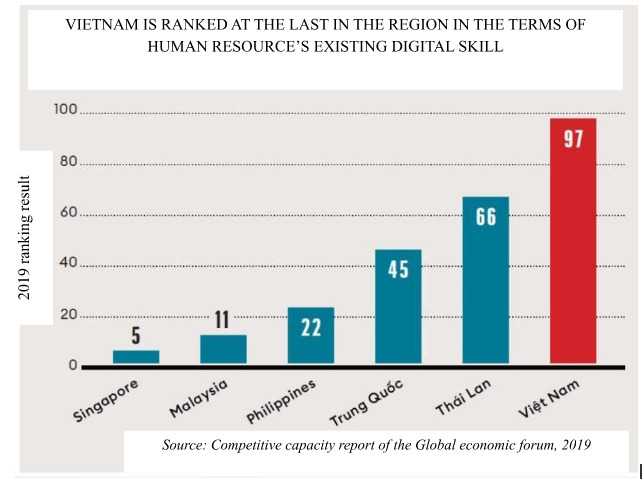
Sai Mr. Tran Dinh Thien, the fourth industrial revolution is the main orientation for mankind to enter into the high-tech economy as an integration of the physical – high-tech economy with the digital economy. High technology and digital economy are mankind’s new development foundation; while the Fourth industrial revolution process brought a strong breakthrough, with an unprecedented high speed. From both angles, innovation – creativity plays the role of the strongest development motivation and has the global endless potential in the coming time.
Source : VietNam.Net


