
Table of Contents
Over the past few years, mobile money development has gained a growing interest among the Vietnamese business community and policymakers. They view it as the key to unlocking the door to a progressive digital society. Though Vietnamese people are still reluctant to experience new methods of payment, the deployment of mobile money in recent years has seen certain achievements.
Potentials to harness money mobile service
The invention of various sorts of payment systems has provided consumers with diverse purchase methods for various goods and services over the past decades. In the early 20th century, mobile money was introduced to the world. It followed the consistent theme which was: Making payments more convenient and transactional for users. According to GSMA, in 2021, users registered more than 1.35 billion mobile money accounts worldwide, a tenfold increase from 134 million in 2012. In 2022, GSMA expects account growth to come from both long-established and nascent mobile money markets, especially South Asia and African countries.
Mobile money was introduced in Vietnam 20 years later than in the world. However, the Government approached this sort of payment in a novel way. Mobile money pilot program targeted the underprivileged groups of customers, who could not have a chance to access traditional banking services.
According to the State Bank of Vietnam, over 30% of the Vietnamese population does not have a bank account and there is still a limit on Internet accessibility among the rural population. As a result, many are excluded from financial and social support such as distributing subsidies and social funds. Therefore, mobile money is expected to penetrate the rural market, enable the government to initiate support activities in remote areas and facilitate their economic development. In return, this will lead to the improvement of people’s living standards in those areas and the overall development of the Vietnam economy.
Mobile money has gained popularity all over the world. Meanwhile, in Vietnam, it is still a relatively new service. However, according to Statista, in 2021, the number of mobile users in Vietnam amounted to an estimated 71.54 million. That number is projected to reach 82.15 million by 2025.
In support for the development of mobile money, the Vietnamese Government has assisted and promoted three leading Vietnam telecom providers, including Viettel Military Industry and Telecoms Group (Viettel), the Vietnam Posts, Telecommunications Group (VNPT) and Vietnam Mobile Telecom Services (Mobifone). Therefore, Vietnam is a huge potential market to harness the money mobile service.
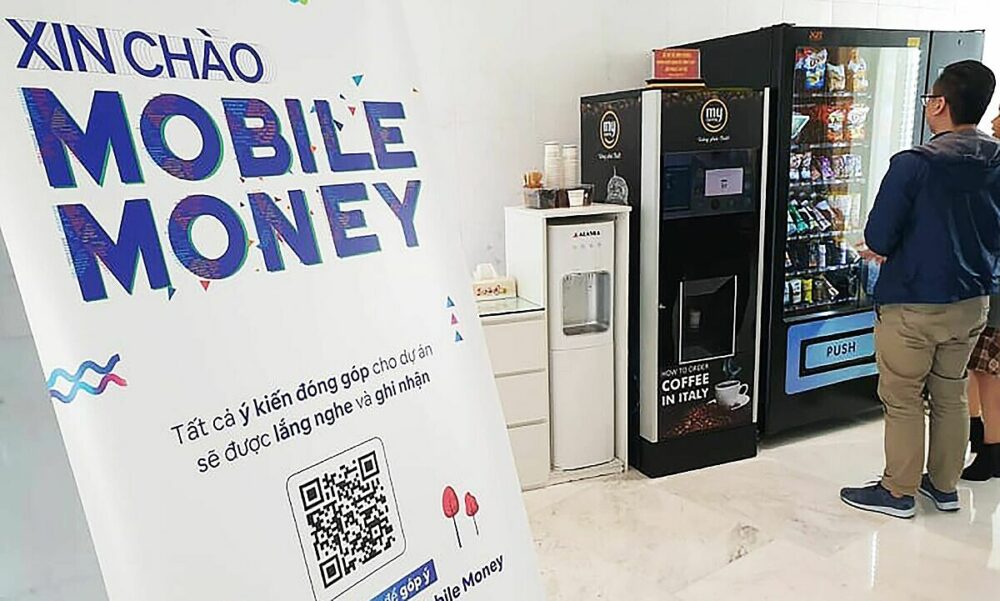
In the beginning, telecom service operators highlighted that even if the technology existed, convincing Vietnamese people to use new methods is quite challenging. Though the introduction of mobile money in Vietnam faced certain obstacles, thanks to the continuous effort of the Government and telecom providers, the recent years have witnessed a significant increase in mobile money accounts across the country.
How mobile money is effectually promoted in Vietnam
To develop the digital economy, the government has urged the use of non-cash payments in general and the deployment of mobile money in particular. In this way, Vietnam has launched a mobile money service (MMS) pilot program since March 2021. In November 2021, the State Bank of Vietnam officially licensed three carriers, VNPT, Mobifone and Viettel, to pilot MMS. The Government has built mechanisms to manage and supervise the deployment of MMS, which demonstrates their substantial investment.
Just one month after MMS was launched, there were 436,000 mobile money users, according to the Ministry of Information and Communications (MIC). The number skyrocketed to over 1 million users after 6 months with the increase in the number of users in rural and mountainous areas. There have been over 3,000 business points accepting money through the digital service. Noticeably, to popularize the service to the public, Viettel has set up 80,000 points to provide consultations and support customers in registering and using the service.
According to the Deputy General Director of Viettel Digital Services Corporation, the COVID-19 pandemic has emphasized the necessity to universalize digital payments. Users may simply conduct cashless transactions just through their mobile money accounts regardless of having Internet connection or bank account. Hence, mobile money continues to play a vital role in expanding trade opportunities and overcoming geographical and technical differences, even in the new normal.
In addition, the development of mobile money will significantly support digital transformation and expand the use of cashless payment services among rural and mountainous populations. The government continues to promote telecom operators to transform telecommunications infrastructure into digital infrastructure. In the long term, this will be a crucial contributor to the deployment of e-government, the national digital economy and society.
The significant effort to promote mobile money services shows that the Vietnamese Government is paying great attention to the digital transformation. They view it as the key to economic recovery and growth after the pandemic. However, the digitization of all economic sectors is quite a long journey to go. Vietnam has developed innovative approaches by discussing new policies, launching pilot programs and encouraging changes from start-up businesses and small and medium-sized enterprises. This makes Vietnam’s digital economy a worthwhile cooperation and investment opportunity.
With profound insight into the Vietnam market and updates in Vietnamese consumers’ preferences, Viettonkin is confident to provide you with guidance and assistance to optimize your investment opportunity in our country. Let us be your companion and help you along the way!


