
Table of Contents
Navigating Vietnam’s labor market in Q3 of 2023 requires a profound understanding of the intricacies that define this dynamic landscape. In this article, we’ll delve into the key trends, challenges, and opportunities within Vietnam’s labor market for this quarter, shedding light on crucial insights, particularly concerning employment rates. As the workforce landscape continuously evolves, it’s essential for businesses, job seekers, and policymakers to remain informed about the ever-changing dynamics in the labor market in Vietnam.
Key Trends and Insights in Vietnam’s Labor Market
Labor Force and Skills Development in Vietnam
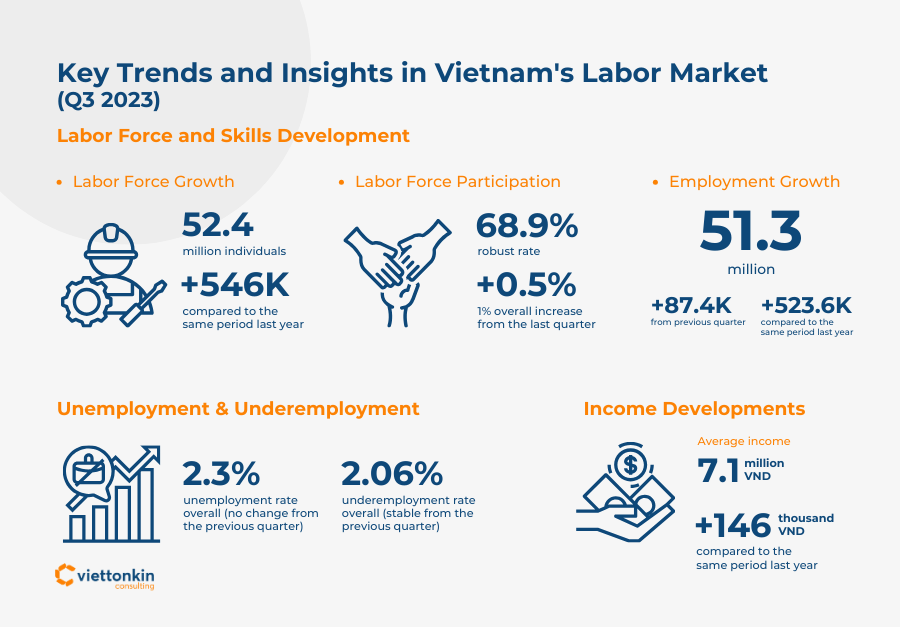
In the third quarter of 2023, Vietnam’s labor force aged 15 and older continued to expand, reaching an estimated 52.4 million individuals. This figure marks an increase of 92.6 thousand people compared to the previous quarter, demonstrating the ongoing dynamism of the labor market in Vietnam. Moreover, there’s a remarkable growth of 546 thousand people compared to the same period last year. The labor force participation rate remained robust at 68.9%, the same as the previous quarter, but up by 0.2 percentage points compared to the same period last year. Of significance, the proportion of trained workers holding degrees and certificates witnessed an increase, rising by 0.5 percentage points from the last quarter, and an overall increase of 1 percentage point.
Employment in Vietnam was a cornerstone in the third quarter of 2023, with an estimated 51.3 million people being employed. This represents an increase of 87.4 thousand people compared to the previous quarter, indicating a growing Vietnamese labor market. Over the same period last year, there was a substantial increase of 523.6 thousand employed persons, showcasing the sector’s resilience and expansion.
Unemployment and Underemployment in Vietnamese Labor Market
As reported by the General Statistics Office (GSO), during the third quarter of 2023, the unemployment rate in Vietnam’s labor market among the working-age population remained 2.3%, with no change compared to the previous quarter. However, there was a slight increase of 0.02 percentage points from the same period the previous year. Zooming out to a broader perspective, the unemployment rate for the initial 9 months of 2023 was 2.28%, reflecting a decrease of 0.07 percentage points compared to the same period in the previous year. This change is particularly notable, with urban areas registering a 2.73% unemployment rate, while rural areas reported a slightly lower rate of 2%.
Concurrently, the underemployment rate for the working-age population in the third quarter of 2023 stood at 2.06%, showing stability when compared to the preceding quarter but exhibiting a rise of 0.14 percentage points when measured against the same period last year. Over the course of the first 9 months of 2023, the underemployment rate reached 2.02%, marking a decline of 0.27 percentage points compared to the same period the previous year. These underemployment statistics shed light on the nuances and shifts within Vietnam’s labor market.
Income Developments in Vietnam’s Labor Market
In accordance with the “Socio-Economic Situation In The Third Quarter And Nine Months Of 2023” report, the labor market in Vietnam witnessed income advancements in the third quarter of 2023. During this period, the average income of workers reached 7.1 million VND per month, showcasing a significant increase of 146 thousand VND compared to the second quarter of 2023. These rising income trends signify positive economic shifts. When analyzed in the broader context of the first 9 months of 2023, the average income of workers amounted to 7 million VND/month, a growth of 6.8% and an equivalent of 451 thousand VND compared to the same period the previous year. These positive income dynamics reflect the economic vitality and opportunities within Vietnam’s labor market.
Challenges and Opportunities in Vietnam’s Labor Market
The integration of Vietnam into the ASEAN Economic Community (AEC) and various Free Trade Agreements (FTAs) has ushered in both prospects and challenges for job seekers.
Opportunities for Job Seekers in Vietnamese Labor Market
The International Labor Organization (ILO) and Asian Development Bank (ADB) conducted a study revealing that AEC’s influence on Vietnam’s GDP is projected to lead to a 14.5 percent growth by 2025, accompanied by a 10.5 percent increase in the number of jobs. Furthermore, with the European Union-Vietnam Free Trade Agreement (EVFTA) in effect, job demand for skilled workers is estimated to surge by 28 percent, while low-skilled workers will see a 23 percent increase, and highly skilled workers will experience a 13 percent rise. These developments signify a golden opportunity to enhance the livelihoods of millions.
The Institute of Labor Science and Social Affairs anticipates that, thanks to EVFTA, Vietnam is poised to witness the creation of 18,000 to 19,000 additional jobs annually between 2021 and 2030, primarily within the production and service sector. The demand for workers will be most prominent in four key industries: electronics and IT, mechanical engineering, chemicals-plastics-rubber, and food and foodstuff processing, together constituting 21 percent of the job market. Meanwhile, the remaining 79 percent of demand will be distributed across nine other business and service fields, covering a wide spectrum of opportunities.
Challenges Faced by Job Seekers in Vietnamese Labor Market
While opportunities abound, job seekers must navigate certain challenges in Vietnam’s dynamic labor market. The advent of Industry 4.0 implies that businesses must adapt to new, high-tech production processes, necessitating workers with professional and technical qualifications, alongside a diverse skill set.
The AEC and EVFTA have fostered an ‘open labor market’ that enables workers to explore job prospects across member countries. Eight specific occupations, including accountants, architects, medical practitioners, nurses, dentists, technical consultants, surveyors, and those in the travel industry, enjoy the freedom of movement within ASEAN, facilitated by mutual recognition agreements. However, with the increased labor mobility, market competitiveness becomes a paramount concern. Vietnamese workers find themselves competing with international professionals in their own homeland, underscoring the significance of continuous skill development and adaptation.

Preparing for the Future of Vietnam’s Labor Market
Predicting Future Trends in Vietnamese Labor Market
The landscape of Vietnam’s labor market is ever-evolving, and anticipating future trends is crucial for both job seekers and employers. The continued integration into the global economy and the digital age is set to drive significant shifts. The growth of Industry 4.0 and the demand for professionals with digital and technological skills will remain at the forefront. Furthermore, the expansion of e-commerce, financial technology will create numerous opportunities. Environmental sustainability and clean energy industries will also play a pivotal role, emphasizing the significance of eco-friendly and green job skills. Thus, understanding these trends is the first step in preparing for the labor market’s future.

Strategies for Upskilling and Reskilling
To remain competitive in Vietnam’s labor market, upskilling and reskilling are essential strategies. Both job seekers and employers must acknowledge the importance of continuous learning and development. For job seekers, enhancing digital literacy, learning new languages, acquiring technical competencies, and mastering soft skills are crucial steps. Employers, on the other hand, should invest in employee training programs to bridge skills gaps. Collaborations with educational institutions and vocational training centers can facilitate upskilling initiatives.
The government, too, has a role to play. It can provide incentives and policies that encourage lifelong learning and foster a culture of adaptation. Financial and non-financial support to educational and training institutions will be fundamental in preparing the workforce for the dynamic labor market. In conclusion, as Vietnam’s labor market embraces change and innovation, the ability to forecast trends and adapt through upskilling and reskilling will be the linchpin to future success.
Final Thoughts
In summary, Q3 of 2023 has yielded key insights into Vietnam’s labor market, showcasing a dynamic landscape marked by opportunities and challenges alike. With the influence of international agreements and the growing labor force, it’s essential for job seekers and employers to adapt to the changing terrain. To excel in Vietnam’s labor market amidst intensifying employment rates, individuals and businesses must prioritize upskilling and reskilling. Viettonkin, with its deep understanding of the labor market in Vietnam, serves as a trusted partner to guide you through these intricacies. For expert advice and to harness the full potential of Vietnam’s labor market, connect with Viettonkin, your gateway to a prosperous future.


